
Inflammatory Bowel Disease Review for the REx-PN®
Q: What is a key difference between Crohn’s disease and ulcerative colitis?
A. Crohn’s disease can involve the entire GI tract from the mouth all the way down to the anus
B. Ulcerative colitis results in healthy stretches of the intestine between inflamed, unhealthy areas
C. Crohn’s disease has excessive bloody diarrhea with tenesmus
D. Ulcerative colitis has deep ulceration involving the entire thickness of the bowel wall
That’s a challenging one, isn’t it? Before answering that REx-PN® practice question, let’s try to understand what inflammatory bowel diseases are.
Inflammatory Bowel Diseases
Inflammatory bowel disease (IBD) is characterized by chronic inflammation of the digestive tract with periods of remission (no signs and symptoms) and exacerbation (presenting with signs and symptoms of the disease). IBD is, however, an umbrella term for any chronic inflammatory disorder that affects the digestive tract and includes ulcerative colitis and Crohn’s disease.
What is IBD?
Crohn’s disease and ulcerative colitis are inflammatory bowel disorders or IBD. Both conditions share symptoms of diarrhea, abdominal pain and cramps, weight loss, and fatigue. These disorders are most often diagnosed in teenagers and young adults and tend to run in families. Both can result in perforation (hole in the small intestine or colon) and peritonitis (inflammation of the abdominal lining). Dietary modifications are generally required in clients with IBD. This includes increased calories, protein, and fluids. Eating small servings several times per day instead of larger meals is also encouraged.
Medications include corticosteroids and aminosalicylates to decrease inflammation, biological and targeted medications, and immunosuppressants to suppress the immune response.
Let’s Talk About Crohn’s Disease
Crohn’s disease is an IBD that causes the digestive tract to become irritated and swollen. It affects the lining of the digestive tract and can even affect the deeper layers. The location of the affected parts varies among clients. It can involve a small segment or multiple segments of the digestive tract. Crohn’s disease can cause abdominal pain, severe diarrhea, fatigue, weight loss, and malnutrition. It can be extremely painful and even lead to life-threatening conditions.
An important fact about Crohn’s disease is that inflammation can occur anywhere along the GI tract, from the mouth to the anus. The affected parts appear patchy. The ulcers are deep and “cobblestone” in appearance. There are areas of healthy bowel tissue between patches of inflammation; therefore, the pattern is not predictable. This is very important in helping diagnose the type of IBD present.
What about Ulcerative Colitis?
Ulcerative colitis is a type of IBD that causes inflammation and ulcers in the digestive tract. It affects the innermost lining of the sigmoid colon and rectum. Due to it being in different locations, ulcerative colitis is further divided into 4 types: ulcerative proctitis (close to anus), proctosigmoiditis (sigmoid colon or rectum), left-sided colitis (from the rectum to colon), and pancolitis (entire colon).
Ulcerative colitis can cause bloody diarrhea, rectal pain, rectal bleeding, an urgency to defecate, weight loss, fatigue, and malnutrition. The ulcers are more superficial, spread in a continuous pattern up to the colon, and are, therefore, predictable.
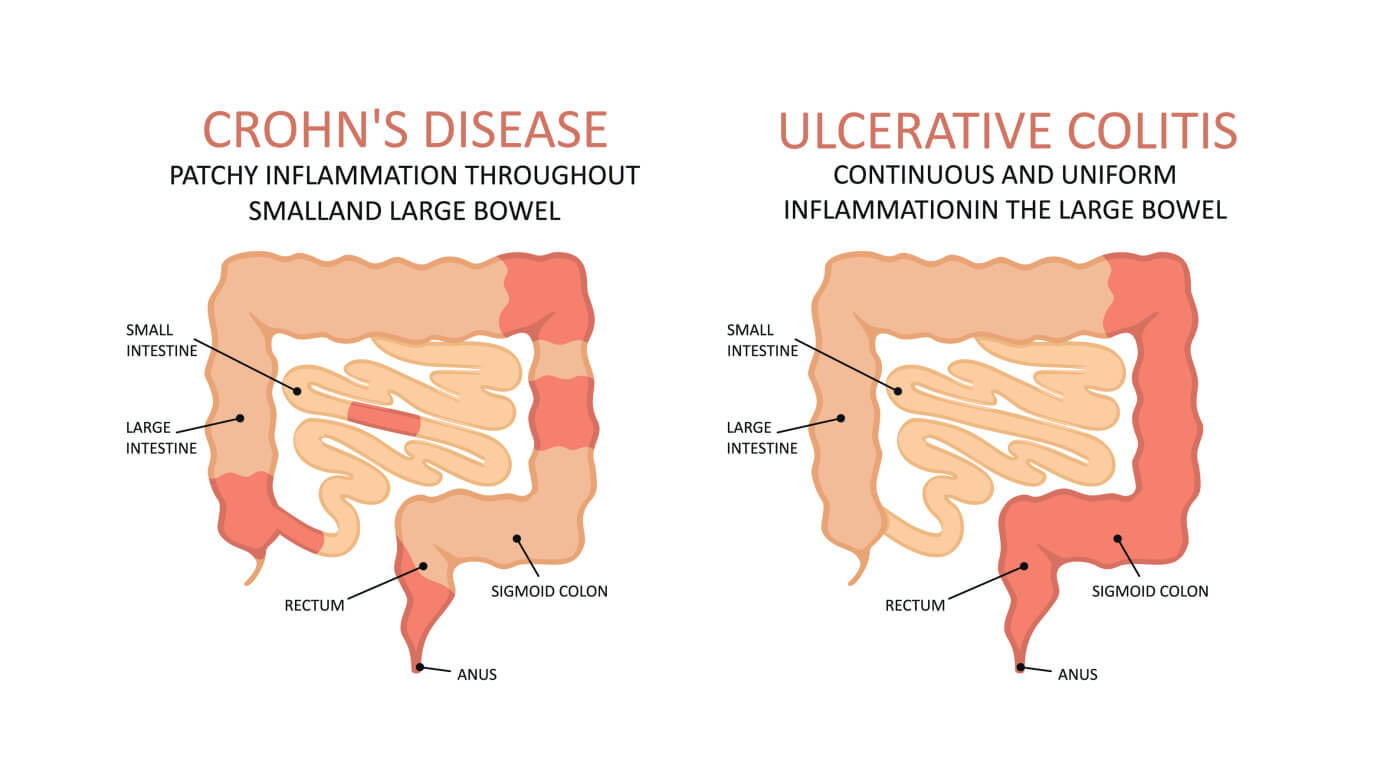
You can refer to the diagram to help differentiate the inflammation/ulcers location and the inflammation/ulcers characteristics for both disorders. Even though the two conditions have different criteria for diagnosis, a clear differentiation cannot always be made between them in many cases as clinical signs are very similar. Using a chart with cue cards is a quick strategy to compare the disorders.
So, we have reviewed both disorders and already know the key difference between the two diseases. You may now answer the REx-PN® practice question above.
Answer: A. Crohn’s disease can involve the entire GI tract from the mouth all the way down to the anus
Check out our test bank here if you want more questions like this. Our review course has helped many students pass! Visit us at CleverOrcaPN.com REx-PN® review.
Study Tips for IBD
Crohn’s disease rhymes with Threes = meaning there are multiple and patchy inflammatory areas around the digestive tract.
Colitis = Collection: all ulcers are in one area (or collected) together.
There’s no need to worry when you’re prepared. You got this!
CleverOrcaPN Team
We are here for you
📧 Got questions? Reach out anytime: support@cleverorcapn.ca
🌟 97% Pass Rate: 🇨🇦 Built by Canadian faculty, made for REx-PN
🇨🇦 Canadian owned and operated
About Us
Become a Partner or Sponsor
REx-PN Exam Guide
Terms and Conditions