The REx-PN Exam: A Complete Guide for Ontario and BC Practical Nursing Students 

If you're finishing a practical nursing program in Ontario or British Columbia, the REx-PN is the exam standing between you and your licence. And if you've spent any time searching for study materials, you've probably run into the same confusion almost every PN student hits: there are NCLEX books everywhere, CPNRE books everywhere, and almost nothing that says REx-PN on the cover. 

This guide covers everything you actually need to know — what the exam is, how the adaptive format works, what's on it, how to register, what it costs, what happens if you don't pass, and, importantly, which review materials are worth your money and which ones will teach you the wrong scope of practice. Everything here is checked against the official sources: the REx-PN Test PlanNCSBN, the College of Nurses of Ontario, and BCCNM

Table of Contents

What is the REx-PN? 

The REx-PN — the Regulatory Exam – Practical Nurse — is the entry-to-practice exam for practical nurses in Ontario and British Columbia. Passing it is one of the requirements for registration with the College of Nurses of Ontario (CNO) or the British Columbia College of Nurses and Midwives (BCCNM).

It exists to protect the public. It isn't testing everything you learned in your program; it's testing whether you have the knowledge, skill and judgment to practise safely as an entry-level practical nurse in your first year on the floor.

The exam was developed by NCSBN in partnership with CNO and BCCNM, and it launched on 4 January 2022. Before that date, PN students in Ontario and BC wrote the CPNRE, the exam still used across the rest of Canada.

Every question on the REx-PN traces back to a real nursing activity identified in the REx-PN Practice Analysis — a survey of what newly registered PNs in Ontario and BC actually do at work. The first one surveyed 6,625 newly registered PNs: 5,863 RPNs in Ontario and 762 LPNs in BC. That's the basis for what you get tested on.

Why this matters for your studying: the exam is built on Ontario and BC practice. Not American practice. Not the rest of Canada's practice. Hold onto that, because it's the single most important thing when you choose study materials.

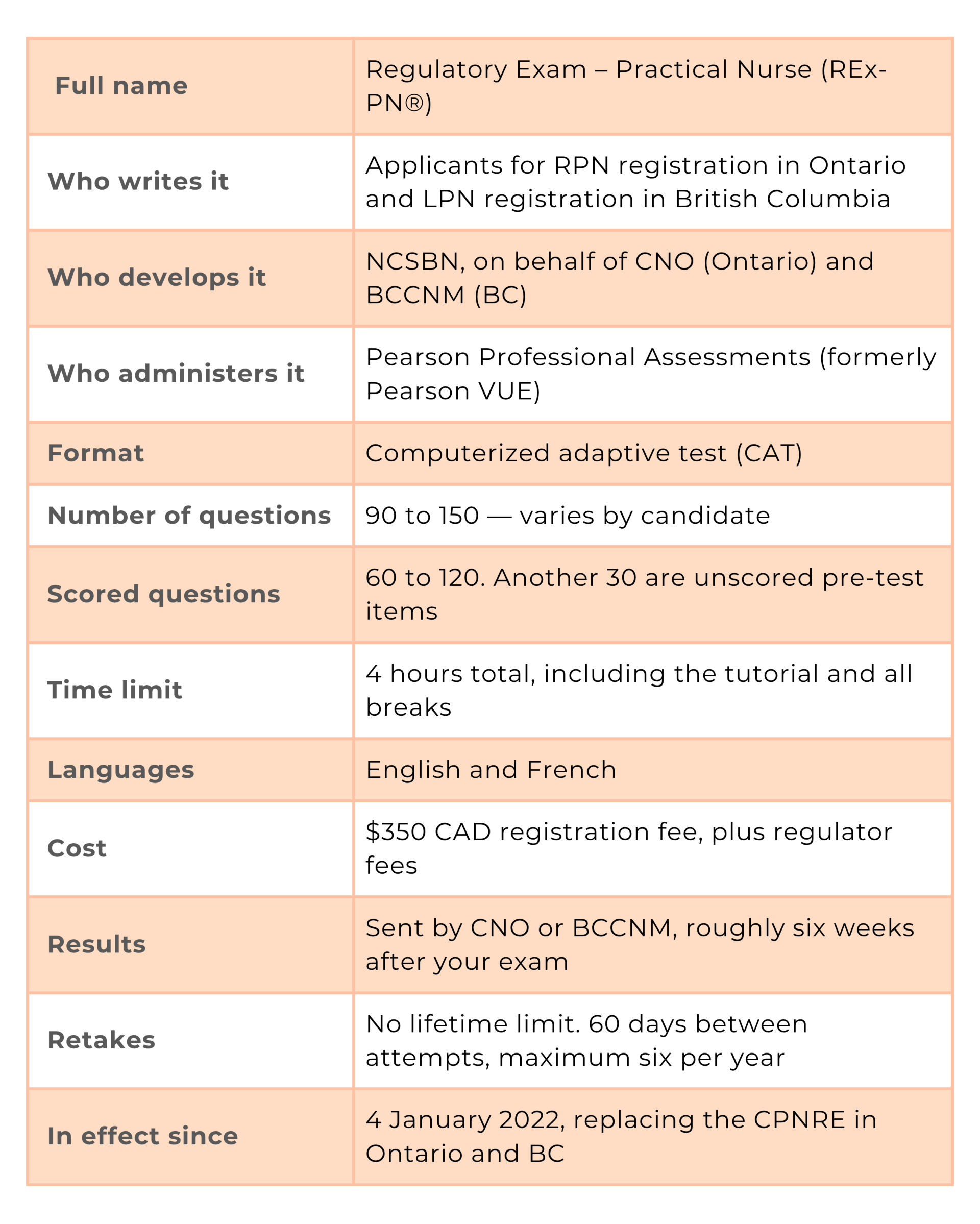
The REx-PN at a glance

REx-PN at a glance: Full name: Regulatory Exam – Practical Nurse (REx-PN®). Who writes it: applicants for RPN registration in Ontario and LPN registration in British Columbia. Who develops it: NCSBN, on behalf of CNO (Ontario) and BCCNM (BC). Who administers it: Pearson Professional Assessments, formerly Pearson VUE. Format: computerized adaptive test (CAT). Number of questions: 90 to 150, varying by candidate. Scored questions: 60 to 120, with another 30 unscored pre-test items. Time limit: 4 hours total, including the tutorial and all breaks. Languages: English and French. Cost: $350 CAD registration fee, plus regulator fees. Results: sent by CNO or BCCNM roughly six weeks after the exam. Retakes: no lifetime limit; 60 days between attempts, with a maximum of six attempts per year. In effect since: January 4, 2022, replacing the CPNRE in Ontario and British Columbia.

Do I write the REx-PN, or a different exam?

This is where most of the confusion lives, so let's clear it up properly.

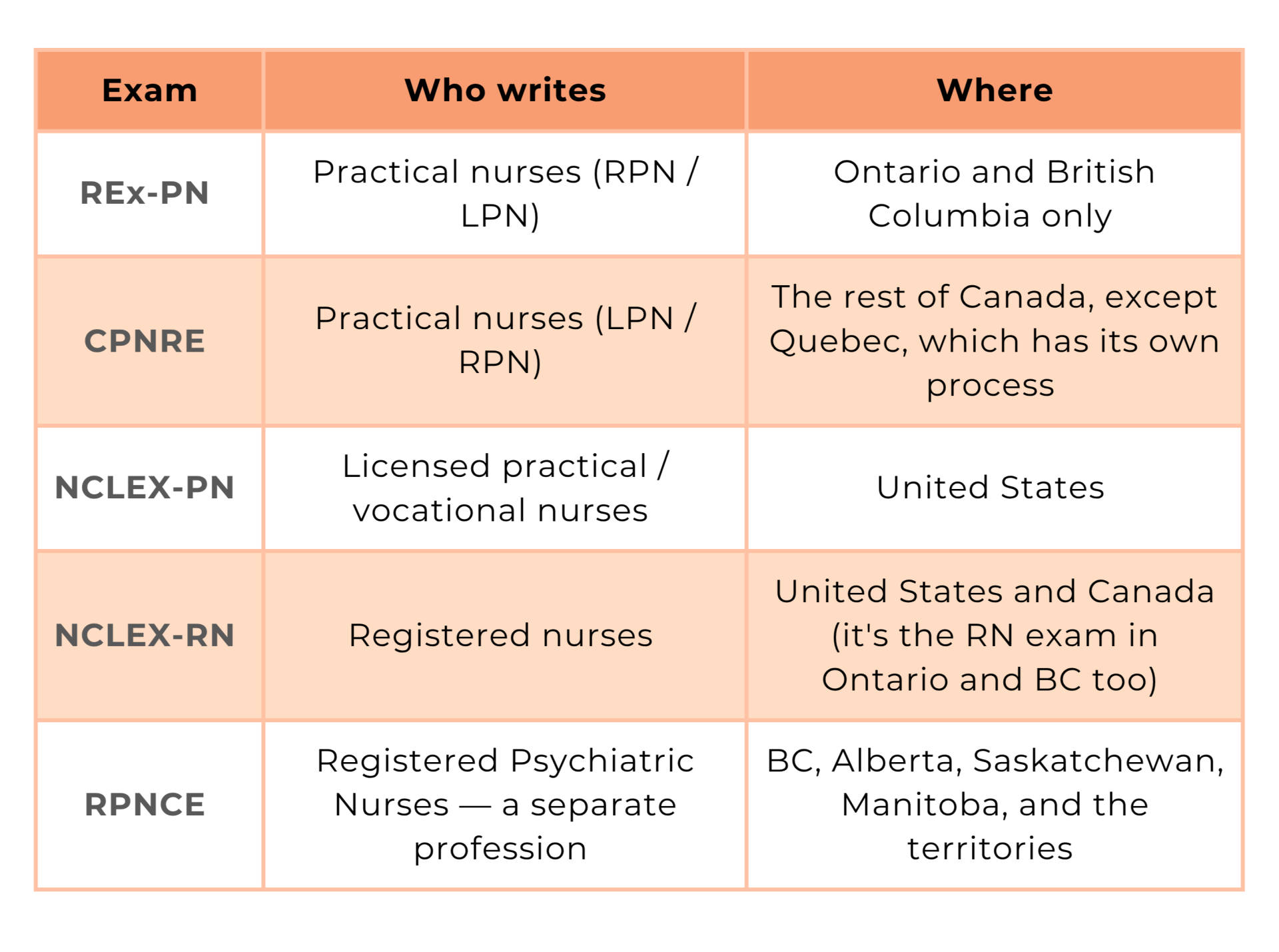
Which exam goes with which license

Comparison of nursing exams by candidates and location. REx-PN: practical nurses (RPN/LPN) in Ontario and British Columbia only. CPNRE: practical nurses (LPN/RPN) in the rest of Canada, except Quebec, which has its own process. NCLEX-PN: licensed practical or vocational nurses in the United States. NCLEX-RN: registered nurses in the United States and Canada; it is also the RN exam in Ontario and British Columbia. RPNCE: Registered Psychiatric Nurses, a separate profession, in British Columbia, Alberta, Saskatchewan, Manitoba, and the territories.

Short version: if you're applying to CNO in Ontario or BCCNM in British Columbia to work as a practical nurse, you write the REx-PN. There is no alternative. CNO has confirmed the CPNRE is no longer an option for Ontario applicants.

A note on the letters "RPN"

This trips people up constantly, especially in BC.

  • In Ontario, RPN means Registered Practical Nurse — that's you, and you write the REx-PN.
  • In British Columbia and Western Canada, RPN usually means Registered Psychiatric Nurse — a separate profession with its own education and its own exam, the RPNCE.
  • In BC, a practical nurse is an LPN — Licensed Practical Nurse.

Same three letters, two completely different professions. If you're searching for study materials and you land on something for "RPNs" that's all psychiatric nursing, that's why.

I already have an LPN license in another province

If you already hold active practising registration as an LPN or RPN elsewhere in Canada, you generally don't rewrite the exam to register in Ontario or BC — labour mobility provisions usually apply. Contact CNO or BCCNM directly to confirm your pathway.

I'm an internationally educated nurse 

You'll need your credentials assessed before you can be made eligible to write. In Ontario, that means a report from an approved educational credential assessment service before CNO can assess your application. In BC, BCCNM will direct you through their process. Once your regulator declares you eligible, you register with Pearson like everyone else.

REx-PN vs NCLEX-PN vs NCLEX-RN vs CPNRE
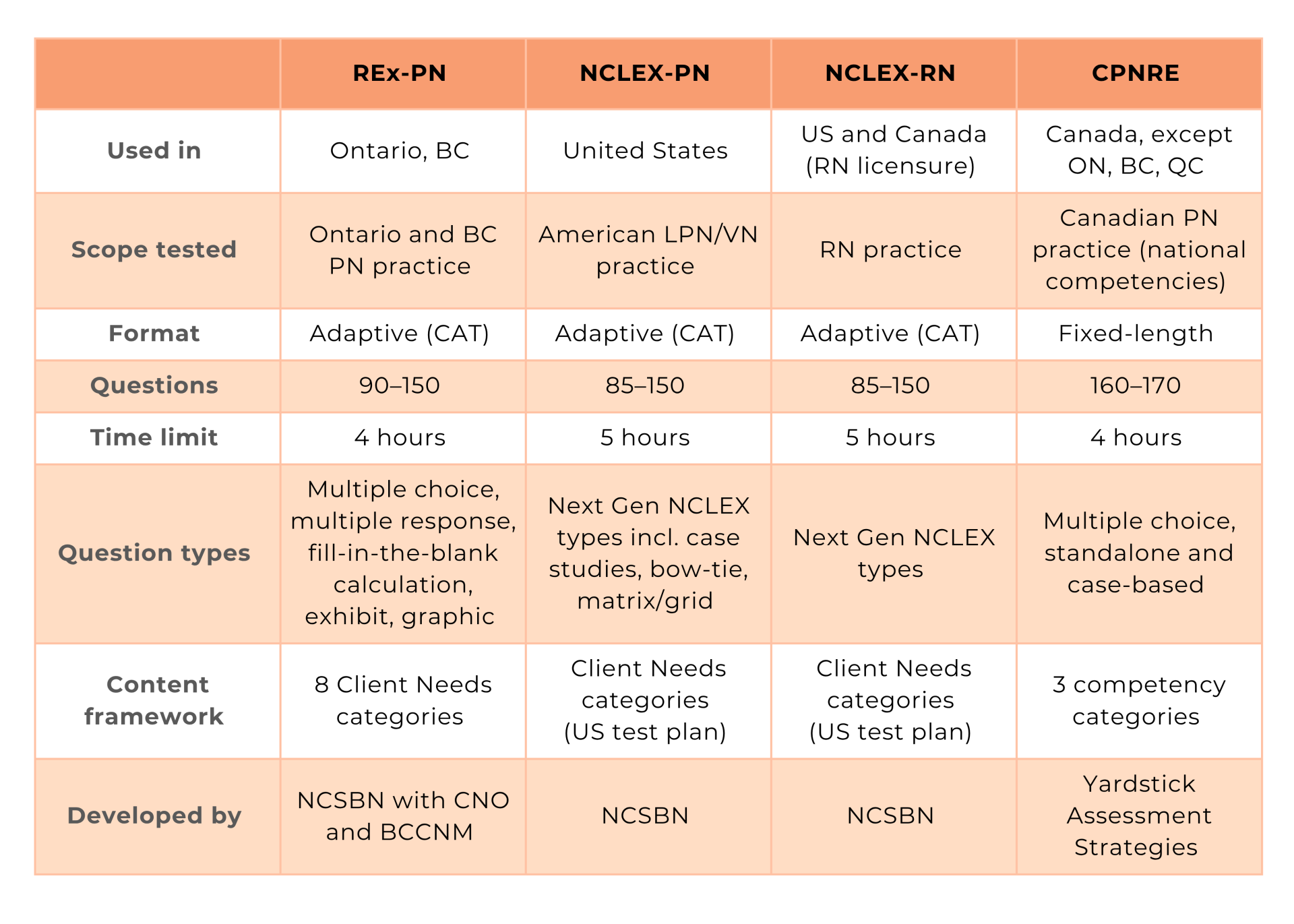
Comparison of REx-PN, NCLEX-PN, NCLEX-RN, and CPNRE nursing exams. REx-PN: used in Ontario and BC; tests Ontario and BC practical nursing practice; adaptive CAT format; 90–150 questions; 4-hour limit; multiple choice, multiple response, fill-in-the-blank calculation, exhibit, and graphic questions; 8 Client Needs categories; developed by NCSBN with CNO and BCCNM. NCLEX-PN: used in the United States; tests American LPN/VN practice; adaptive CAT format; 85–150 questions; 5-hour limit; Next Gen NCLEX question types including case studies, bow-tie, and matrix/grid; Client Needs categories based on the US test plan; developed by NCSBN. NCLEX-RN: used in the US and Canada for RN licensure; tests RN practice; adaptive CAT format; 85–150 questions; 5-hour limit; Next Gen NCLEX question types; Client Needs categories based on the US test plan; developed by NCSBN. CPNRE: used in Canada except Ontario, BC, and Quebec; tests Canadian practical nursing practice and national competencies; fixed-length format; 160–170 questions; 4-hour limit; multiple-choice, standalone, and case-based questions; 3 competency categories; developed by Yardstick Assessment Strategies.

So can I study with NCLEX materials?

Partly — and the choice between NCLEX-PN and NCLEX-RN materials matters more than most students expect.

The scope of practice for practical nurses in the United States is narrower than ours. Registered Practical Nurses in Ontario and Licensed Practical Nurses in BC do more, and are accountable for more. That gap shows up most sharply in delegation and prioritization questions — which is a real problem, because the NCLEX-PN is written for American practice, and delegation and prioritization are exactly where the REx-PN concentrates its weight.

NCLEX-RN materials are the safer borrow. You may hit a handful of ICU-level questions outside your scope, but the clinical content — gallbladder disorders, cardiac conditions and the like — is broadly relevant to you, and the reasoning style sits much closer to what the REx-PN asks.

Our PN faculty see this play out every cohort. Around week three or four of a review, when Management of Care comes up, students have to work out what an RPN can and cannot delegate — and the correct answers are genuinely different from what an American practical nurse would do.

So, to put it plainly: if you're going to lean on NCLEX materials, the RN version is usually the safer borrow, not the PN version. The RN book might take you slightly out of scope on a few clinical topics. The PN book will actively teach you an American practical nurse's scope of practice, and Management of Care alone is 18–24% of your exam.

What about CPNRE review books?

Don't use them as your primary resource. The CPNRE was the Ontario and BC exam before 2022, so there's a lot of it floating around in libraries, on used-book sites, and in older students' hands. But the question format changed substantially. When the REx-PN blueprint was built, it moved much closer to the RN NCLEX style than to the CPNRE.

Our faculty are blunt with students about this one: CPNRE review materials are no longer a good preparation resource for the exam you're actually writing.

One exception worth keeping in mind: if you're planning to write the American licensure exam later, hang onto your NCLEX-PN books. They're the right resource for that. Just not for this.

How computerized adaptive testing actually works

The REx-PN is a CAT, which means it isn't the same exam for everyone. Understanding the mechanics genuinely reduces exam-day anxiety, so it's worth two minutes.

The exam adjusts to you

Every candidate starts fresh. After each answer, the computer re-estimates your ability and selects the next question accordingly. It aims for questions you have roughly a 50% chance of answering correctly — hard enough to be informative, not so hard you're guessing blindly.

This has a strange side effect that catches people off guard: the exam is supposed to feel difficult. If you're finding it hard, that's the algorithm working as designed. It isn't a sign you're failing.

You can't skip, and you can't go back

Every question must be answered before you move on. Once you confirm an answer and press Next, it's locked. Your answer has already been factored into the ability estimate, so there's no going back to change it.

Practically: read carefully, commit, move forward. Don't spend the rest of the exam replaying question 14.

Why the exam length varies

The exam stops when it has enough information to make a decision:
  • The 95% confidence rule — the most common outcome. The computer stops as soon as it's 95% certain your ability is clearly above or clearly below the passing standard. This can happen anywhere from 90 questions onward.
  • Maximum length — if your ability sits very close to the passing standard, the exam runs to 150 questions and then judges you on your final ability estimate.
  • Run out of time — if the four hours expire before a decision is reached, you're judged on your final ability estimate, provided you answered the minimum number of questions. If you didn't, you automatically fail.

A short exam does not mean you failed, and a long exam does not mean you failed. People pass at 90 questions and people pass at 150. The length tells you nothing about the result.

The 30 questions that don't count

Every REx-PN includes 30 unscored pre-test questions. They're being trialled for future exams. They look identical to scored questions and you'll never know which is which — so give every question your full effort.

Repeat questions and repeat attempts

If a question feels similar to one you saw earlier, don't read anything into it. Items can cover similar conditions while testing different phases of the nursing process, and one of them may be an unscored pre-test item. It does not mean you got the first one wrong.

If you're rewriting the exam, the system knows. It excludes questions you've already seen from the current pool, so you get a fresh set.

What's on the REx-PN

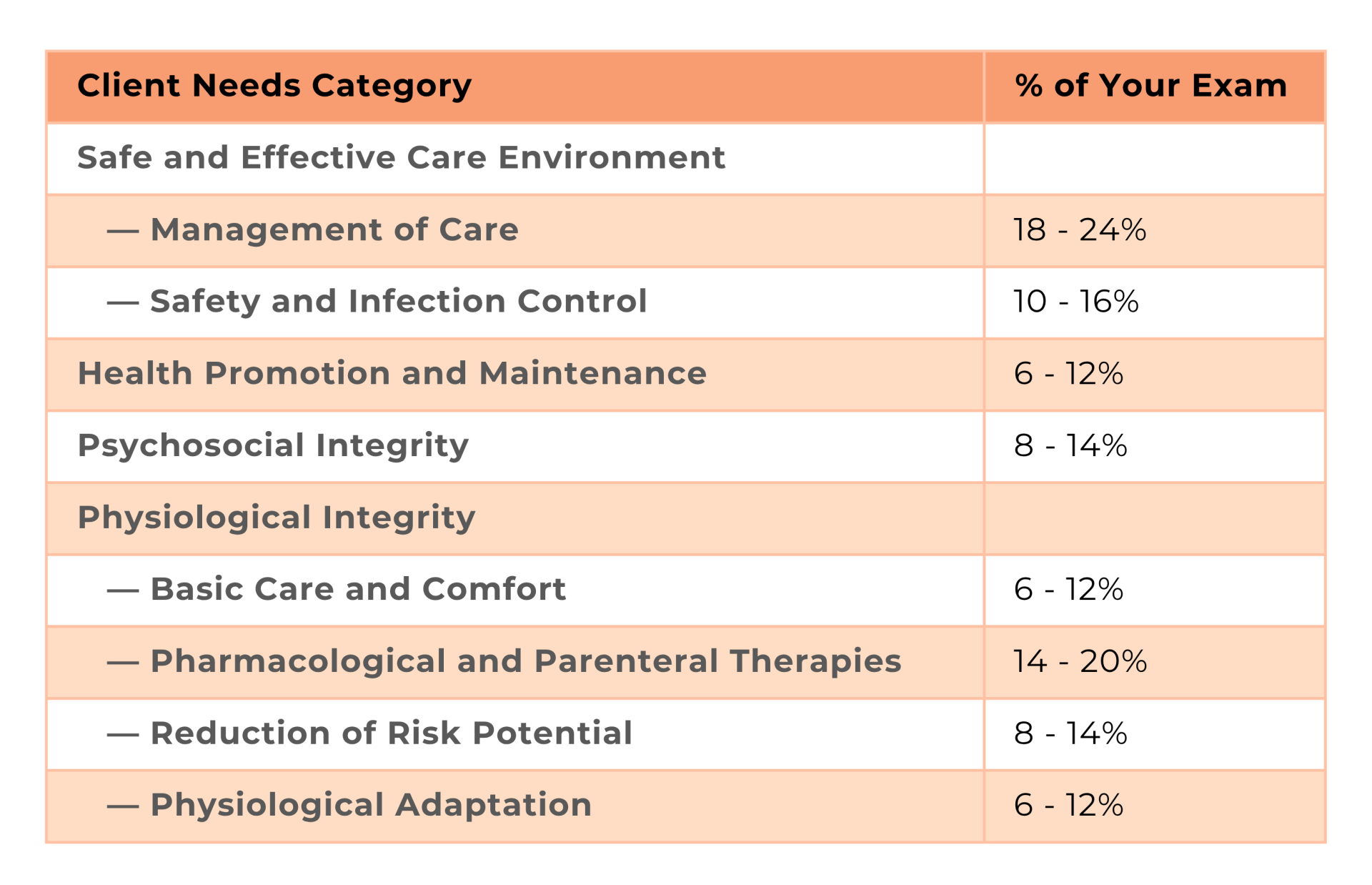
The REx-PN Test Plan organises the exam into eight Client Needs categories. Each has a target percentage range, and any individual exam can vary by up to 3% either way.
REx-PN Client Needs categories and percentage of the exam: Safe and Effective Care Environment includes Management of Care, 18–24%, and Safety and Infection Control, 10–16%. Health Promotion and Maintenance, 6–12%. Psychosocial Integrity, 8–14%. Physiological Integrity includes Basic Care and Comfort, 6–12%; Pharmacological and Parenteral Therapies, 14–20%; Reduction of Risk Potential, 8–14%; and Physiological Adaptation, 6–12%.
Where to concentrate: Management of Care and Pharmacological and Parenteral Therapies together account for roughly a third of your exam. Delegation, supervision, prioritization, scope of practice, medication administration and calculations. If your study time is limited, that's where it goes.

Six processes woven through everything

These aren't separate sections — they're integrated across all eight categories:
  • Nursing Process — assessment, analysis, planning, implementation, evaluation
  • Caring — mutual respect and trust in the nurse-client relationship
  • Communication and Documentation — verbal, nonverbal, and written or electronic records
  • Teaching and Learning — helping clients make autonomous decisions
  • Culture and Spirituality — care shaped by the client's own preferences and identity
  • Client Safety — continually assessing, preventing and managing unsafe situations

Indigenous health knowledge and practices appear explicitly in the test plan under Psychosocial Integrity, as does care for clients with acute and chronic mental health disorders.

Question types you'll see

Most questions are standard multiple choice with four options. You'll also see:
  • Multiple response (select all that apply)
  • Fill-in-the-blank calculation — round at the end of the calculation, and follow the instruction about whole numbers or decimals
  • Exhibit questions
  • Graphic questions

An important scoring change:
From January 2026, multiple response / select-all-that-apply items are scored for partial credit rather than all-or-nothing. Every other item type is still simply correct or incorrect. This is genuinely good news, a SATA question you're partly right about now earns you something.

Practical details about the questions

  • Medications appear by generic name in most cases, not brand names. Some items refer to drug classes. There is no official list of drugs that will appear.
  • Lab values are metric.
  • A calculator is built into the exam software.
  • Practice settings are stated when they're relevant to the question. There's no default setting to assume.
  • Questions are numbered, so you can see how many you've answered.

The lab values you're expected to know

The test plan specifies which values you must have memorized. Everything else will be provided in the question.
ABGs (pH, PO₂, PCO₂, SaO₂, HCO₃) · BUN · total cholesterol · creatinine · glucose · glycosylated hemoglobin (HbA1C) · hematocrit · hemoglobin · INR · platelets · potassium · PT · PTT and APTT · sodium · WBC
That's the list. It's shorter than most students fear.

What is NOT on the REx-PN

Worth knowing, because it saves you wasted study time.

The REx-PN does not test knowledge of Canadian health care systems, health care history, government policy, or legislation. Those things vary province to province, and testing them isn't the exam's purpose.

That knowledge is tested separately, on the Jurisprudence Exam — a different, open-book exam covering nursing regulation, by-laws, and practice standards. In Ontario, CNO's jurisprudence exam is open book and can be repeated as many times as you need.

Two exams. Don't mix up your study plans for them.

How to register for the REx-PN

Registration happens in two stages, and you can't skip ahead: your regulator first, then Pearson.
  1. Apply to your regulator. CNO in Ontario, BCCNM in British Columbia. They assess your credentials and decide whether you're eligible to write. Request exam accommodations at this stage, not later.
  2. Register with Pearson. Once your regulator confirms eligibility, register online or by phone, paying by credit, debit or prepaid card. If no confirmation arrives within two days, contact Pearson before trying again — duplicate registrations aren't refundable.
  3. Wait for your Authorization to Test. The ATT arrives by email and you cannot book an appointment without it. You must test within its validity dates, and they cannot be extended for any reason — miss the window and you re-register and pay the fee again. If you've been declared eligible but no ATT has arrived, request a resend from your Pearson account.
  4. Book your appointment. Any Pearson Professional Centre will do — you don't have to write in Ontario or BC. Canada and the mainland US are domestic rate; other countries add a scheduling fee. Book early, because your preferred date isn't guaranteed.

Full details are on the official registration page.

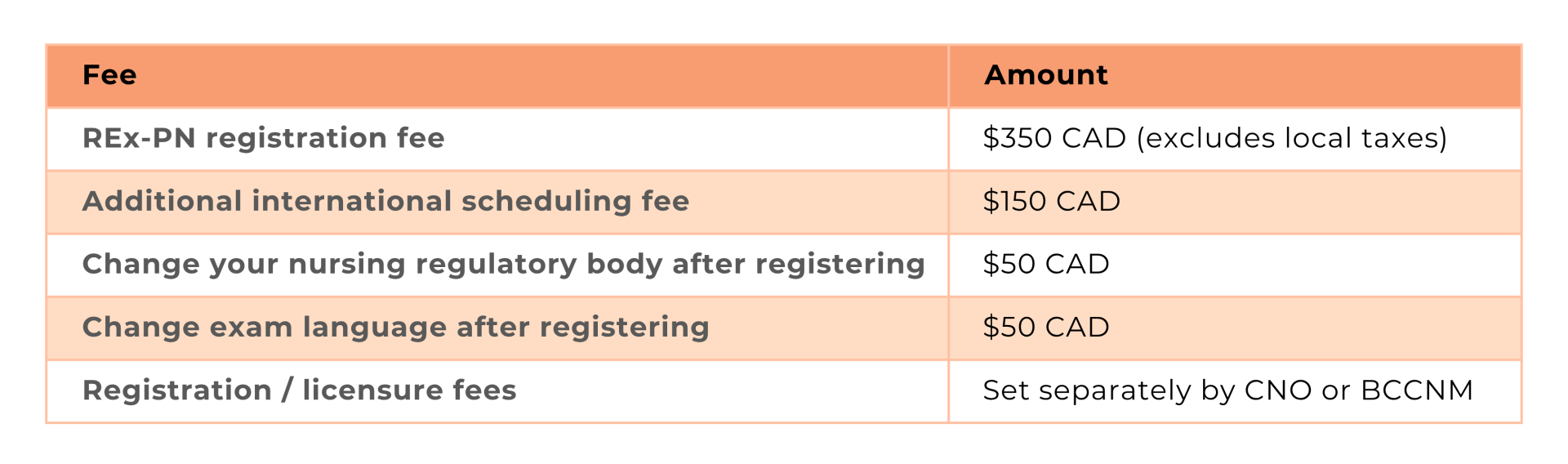
What the REx-PN costs

REx-PN fees: registration fee, $350 CAD excluding local taxes; additional international scheduling fee, $150 CAD; changing your nursing regulatory body after registering, $50 CAD; changing the exam language after registering, $50 CAD; registration or licensure fees are set separately by CNO or BCCNM.
There are no refunds. For any reason. That includes duplicate registrations, failing to cancel more than 24 business hours before your appointment, and simply not showing up. Every attempt costs the full fee again. See the official fees and payment page for current amounts.

Exam day

Bring the right ID

This is the most avoidable way to lose $350. Check the full ID requirements before you go. Your ID must be:
  • Physical, not digital
  • Not expired
  • Government-issued
  • Showing your name in Roman characters
  • Showing a recent photograph
  • Showing your signature

At domestic test centres, acceptable ID includes a passport, driver's licence, provincial or territorial identity card, permanent residence card, or military ID.

At international test centres, only a passport is accepted.

If your ID doesn't meet these requirements, you'll be turned away and you'll re-register and pay again.

How the four hours are spent

The four-hour limit covers everything: the tutorial, sample items, all optional breaks, and the exam itself. Plan accordingly.

Aim for roughly one to two minutes per question. That pace gets you through the maximum 150 questions comfortably. On similar exams, candidates typically take 60 to 90 seconds per question.

Don't rush — but don't stall either. Read the question, consider all four options, commit, move on.

Getting your results

Results come from CNO or BCCNMnot from NCSBN, Pearson, or the test centre. Test centre staff genuinely cannot see them.

Every exam is scored twice: once by the computer at the test centre, then again after the record transmits to Pearson. Your regulator sends official results within approximately six weeks of your exam.

If more than six weeks pass with nothing, contact CNO or BCCNM.

If you don't pass

You'll receive a Candidate Performance Report (CPR). This is genuinely useful, not just a rejection letter. It breaks down your performance in each content area, showing whether you were above, near, or below the passing standard in each one.

Use it. It tells you exactly where your study time should go before your next attempt.

The passing standard

There's no percentage to hit. Because the exam is adaptive, there's no fixed number of correct answers that equals a pass — every question carries a different difficulty weight.

You pass when the computer determines your ability is above the passing standard: the minimum ability needed to practise safely as an entry-level PN. The current standard is −0.32 logits, in effect from 4 January 2022 through 31 December 2026. It's re-evaluated every five years.

Retaking the REx-PN

There is no lifetime limit on attempts. This changed with the REx-PN — under the old CPNRE, Ontario applicants had only three attempts. The official retake policy sets out the rules.

The rules:
  • 60 days minimum between attempts
  • Maximum six attempts per calendar year
  • A new fee every time
  • Your regulator may require additional steps before making you eligible again

The retake steps
: contact CNO or BCCNM to tell them you're rewriting → they determine what's required to make you eligible → re-register with Pearson and pay → wait for a new ATT → book your appointment.

If you failed the CPNRE three times before 2022 and were referred to the Registration Committee, you can still write the REx-PN. Re-apply to CNO; you don't need to complete a new nursing program.

REx-PN pass rates

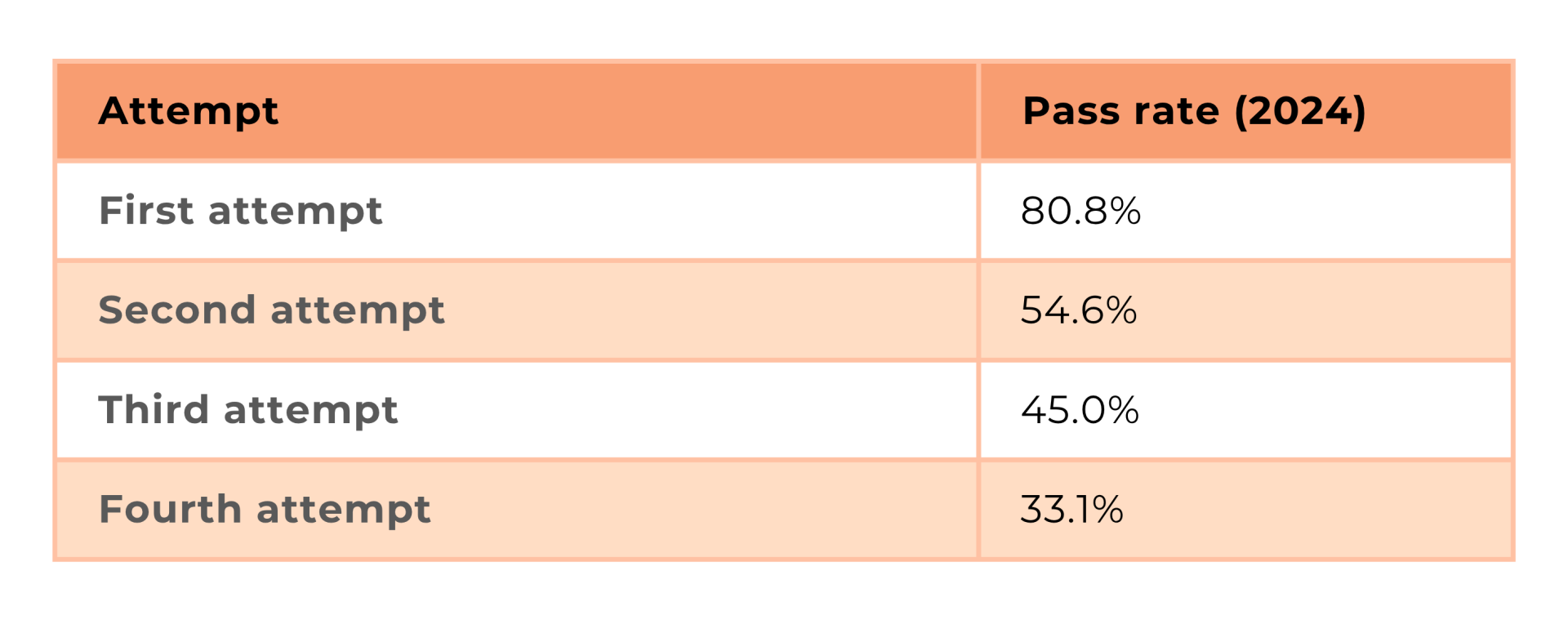
The most recent published figures come from CNO's Nursing Registration Exams Report for 2024, covering Ontario-educated applicants.
REx-PN pass rates by exam attempt in 2024: first attempt, 80.8%; second attempt, 54.6%; third attempt, 45.0%; and fourth attempt, 33.1%.
In 2024, 4,882 Ontario-educated RPN applicants wrote the exam.

Your first attempt is by a wide margin your best attempt. The pass rate doesn't just dip on retakes — it falls off sharply and keeps falling. Unlimited attempts are a genuine safety net, and it's good that they exist. But the data is unambiguous: the students who pass are overwhelmingly the ones who were ready the first time.

Ontario's first-attempt rate has moved between 73.1% and 83.3% across the REx-PN years. BCCNM publishes its own annual statistics for first-time writers from recognised BC practical nursing programs.

Not sure if you're ready?

Take our free REx-PN readiness quiz. A few minutes, no credit card, and a clear picture of where you stand.

So which REx-PN review should you actually buy?

Given everything above, here's an honest framework — including when not to spend money.

Start by ruling things out

Rule out CPNRE materials. Wrong exam, wrong era, wrong question format.

Be cautious with NCLEX-PN materials. They teach American practical nursing scope. Delegation and prioritization answers will be wrong for you, and Management of Care is up to 24% of your exam.

NCLEX-RN materials are a reasonable borrow if that's what you have access to. Slightly out of scope on some clinical content, but the reasoning style and question format are much closer to the REx-PN.

Ideally, use something built for the REx-PN test plan and for Ontario and BC practice. There are a couple of Canadian PN review textbooks that cover the CPNRE and the REx-PN together in a single volume, which is better than an American book but still means a chunk of what you're paying for is NOT your exam. And there's CleverOrcaPN, which we built for the REx-PN alone.

Free official resources you can use:
And there's our FREE REx-PN Quiz. You’ll go through 20 REx-PN questions and get your results, along with full explanations of why each answer is right or wrong. It only takes a few minutes and helps you identify the content areas where you need the most improvement. Definitely worth doing before spending money on anything.

Questions to ask before you buy anything

  1. Was this built for the REx-PN test plan, or adapted from an NCLEX or CPNRE product?
  2. Does it teach the Ontario and BC scope of practice for delegation and prioritization?
  3. Does it explain why each option is right or wrong, or just give you an answer key?
  4. Does it include a timed, full-length mock exam at 150 questions and four hours?
  5. Does it break your results down by content area, so you can act on them?
  6. What happens if you need more time than you planned?

Where CleverOrcaPN fits

We built CleverOrcaPN specifically for the REx-PN — the test plan, the Ontario and BC scope, the format. It was developed by PN faculty, with input from past REx-PN writers.

It's a full review program rather than a question bank alone: study guides, practice questions with full rationales, timed mock exams, results reported by topic, a printed review book, memory techniques, and a study planner.
And we extend your access for FREE until you pass. Zero risk.

See the programme for yourself before you spend anything

Get free access to a full CleverOrcaPN module: study guides, practice questions and rationales. No credit card required.

Frequently asked questions

💭 Can I skip a question and come back to it?

No. When you take the REx-PN, every question must be answered before you move on, and once you press Next you cannot return. This is inherent to how adaptive testing works — your answer has already been factored into the estimate of your ability.

💭Does a short exam mean I failed?

No. The exam ends as soon as the computer is 95% confident you're clearly above or clearly below the passing standard. That can happen at 90 questions or at 150. Length tells you nothing about your result.

💭How many questions do I need to get right to pass?

There's no set number. Each question carries a different difficulty weight, and you pass when your estimated ability sits above the passing standard.

💭Can I use a calculator?

Yes. One is provided on-screen in the testing software.

💭Do I need to memorise normal lab values? 

Only the ones listed in the test plan (ABGs, BUN, cholesterol, creatinine, glucose, HbA1C, hematocrit, hemoglobin, INR, platelets, potassium, PT, PTT and APTT, sodium, WBC). Everything else is provided. 

💭Can I write the REx-PN outside Ontario or BC? 

Yes. Any Pearson Professional Centre that offers the exam. Test centres outside Canada and the mainland US carry an additional $150 CAD scheduling fee. 

💭Is the REx-PN available in French? 

Yes. The test plan, tutorial, candidate bulletin and FAQs are also available in French. You can change your exam language after registering for a $50 CAD fee. 

💭How many times can I write the REx-PN? 

There's no lifetime limit. You must wait 60 days between attempts, which caps you at six attempts per year. Each attempt costs the full fee again. 

💭What's the difference between the REx-PN and the CPNRE? 

The REx-PN is the exam for Ontario and BC; the CPNRE is used across the rest of Canada except Quebec. The REx-PN is adaptive and variable-length; the CPNRE is fixed at 160–170 questions. The REx-PN replaced the CPNRE in Ontario and BC on 4 January 2022. 

💭Can I write the CPNRE instead? 

No. CNO has confirmed the CPNRE is no longer an option for Ontario applicants. If you passed the CPNRE by the end of 2021 as part of a CNO application, that still satisfies the exam requirement. 

💭Is the REx-PN the same as the NCLEX-PN? 

No. Both are developed by NCSBN and both are adaptive, but the NCLEX-PN tests American practical nursing scope and the REx-PN tests Ontario and BC practice. The differences show up most sharply in delegation and prioritization. 

💭Does the REx-PN test Canadian health care legislation? 

No. That's the jurisprudence exam, which is separate. 

💭When do I get my results?  

From CNO or BCCNM, approximately six weeks after your exam. Not from the test centre, Pearson, or NCSBN. 

💭What happens if I don't pass?   

You receive a Candidate Performance Report showing your performance by content area, and you can rewrite after 60 days. 

You've done the hard part already

Nursing school is behind you.
Let's get you walking into that test center feeling ready.
Exam fees, policies and test plan details can change. Always confirm current requirements with CNO or BCCNM before registering. CleverOrcaPN is an independent review provider and is not affiliated with NCSBN, CNO or BCCNM. REx-PN® and NCLEX® are registered trademarks of NCSBN.